Friday, July 31, 2009

The Problem With Marriage....

is feminism. There. It's been said. And what a relief!

Wait, let me back-track a moment here: we, as a society, are all aware that marriage has been a crumbling institution for the past fifty or sixty years. We search for the clues as to why and how to fix the problem (or whether there's a problem at all) but all we see are the statistics: 50% divorce rates, fewer marriages and a lot more cohabitation. The statistics also show a likelihood that cohabiting couples are more likely to call it quits. This, normally, wouldn't be so big a deal-- if you didn't add children to the stew.

And the problem is pretty simple: feminism. Feminism destroyed marriage.

And that's a good thing.


If we go back to the very first concepts of marriage, before those heady days with the idea of "romantic love" was first conceived, marriage was little more than a living, breathing, eternally binding contract. You trade a daughter for a bunch of gold and a financial stake in an up and coming corporation-- In-Laws inc.

Later, you cemented alliances with feudal lords, passed a princess and a few peasants, be sure she gets knocked up and BOOM-- you needn't fight that messy war.

Times changed but it wasn't until postWW2 that the nature of marriage shifted-- until women went to work, marriage was a way to financially secure your daughters, hopefully to someone they could tolerate. It wasn't like women could own a property in all places, or were respected if they did. Thus, the safety of marital bless-- with it's attendant abuses and servitudes (of course, it wasn't all bad-- after all, marriage tends to take the fight out of a man).

Then a funny thing happened. Women started wanting, like, rights and stuff. And jobs. And equality.

And when they happened, they realized they didn't need to be married. So when they got married, while having jobs of their own, divorce wasn't as horrifying a thing.

Fast forward to today and you find women becoming increasingly successful-- and who needs a marriage when you've got a career?

We had a boom in divorce, followed by a bust in marriage-- fewer people doing so, but those who do understand the risk: a coin-flip on whether they'll last. Maybe they're a little more committed-- then again, maybe not--, maybe they're just a bit smarter, having watched a generation of parents divorced... they, like the survivors of some species-wiping cataclysm, have adapted their way into the next step of marriage evolution. And maybe that's a good thing.

You take the money out of marriage and all you're left with is love, hardship and commitment. Love, in the romantic sense, runs dry after a few years. Hardship is something modern Americans aren't used to dealing with (perhaps these new married couples have benefited from a decade of unwatchable romantic comedies). And commitment?

One of the few married couples I know have neatly side-stepped this problem in what I increasingly believe will be the next step in marital evolution: the open marriage.

They are a couple. They live with (and date) another couple. And date a few others, besides.

While I do not understand the mechanics of their particular little sex-nest, I've seen the overall concept executed a few times thusly: there's a primary partner, with a few other secondaries. There are "veto" rules, allowing some measure of control for the other partner (i.e., "no you're NOT sleeping with that particular crazy bitch-- go fuck that nice girl in the corner"). If one partner is feeling unappreciated, there must be some devotion to repairing the primary relationship. Communication is a must. And there has to be at least one MFF threesome.

I just threw that last one in cuz, you know, naturally, that would be my clause.... I just assume that's an unspoken given.

It seems to work out for them but more importantly, it may work out for those who aren't married. After all, some people don't want or need the pressures, stresses and time consumptions of a relationship-- why not, then, just attach yourself to a happily open marriage as a free-agent secondary and let the franchise players worry about the Big Questions.

Personally, I have a hard time with the idea of open marriage-- for myself.

That is probably because I have a hard time with the idea of marriage, period-- that is, once again, for myself.

But if and when I did, I would have all the knowledge that my marriage is fragile, fraught and likely to fail-- and still should be forever. Perhaps the rise in cohabitation shows that, in order to succeed, you should fail a few times-- and if and when you find the person to enter a binding contract with, you'll fight through the hardships, you'll let the love mature and you'll hold to whatever version of commitment you happened to hold with.

Either way, we can't go back to Donna Reed. And we shouldn't. This is a brave new world and we have brave new marriages to go with it.

And hey... let the gays marry, already. They couldn't do any worse at it than straight people, could they? Don't fight it: they're just another step in the evolution. Change is inevitable.

Tuesday, January 13, 2009

Weird Science.

According to the New York Times, it won't be long before we see Love Potion Number 9
When a female prairie vole’s brain is artificially infused with oxytocin, a hormone that produces some of the same neural rewards as nicotine and cocaine, she’ll quickly become attached to the nearest male. A related hormone, vasopressin, creates urges for bonding and nesting when it is injected in male voles (or naturally activated by sex). After Dr. Young found that male voles with a genetically limited vasopressin response were less likely to find mates, Swedish researchers reported that men with a similar genetic tendency were less likely to get married. In his Nature essay, Dr. Young speculates that human love is set off by a “biochemical chain of events” that originally evolved in ancient brain circuits involving mother-child bonding, which is stimulated in mammals by the release of oxytocin during labor, delivery and nursing.

“Some of our sexuality has evolved to stimulate that same oxytocin system to create female-male bonds,” Dr. Young said, noting that sexual foreplay and intercourse stimulate the same parts of a woman’s body that are involved in giving birth and nursing.


Interesting but, in some ways, a bit of a finding in search of a hypothesis-- perhaps we stimulate the same parts of a woman's body that are involved in giving birth and nursing because they also have an unusually large number of nerve cells? And in the case of male fascination with breasts, that isn't even even cross-cultural. Black men prefer booty and a whole shit load of white guys seem to like women who kind of look like boys (I'm just sayin').

What is more interesting, though, is the idea of a love vaccine which, on its surface, seems to be a cure... for monogamy.

For years, the argument (probably made up and advocated by guys) went that men are the biological imperative to spread the seed as far and wide as possible-- and that women are more suited to monogamy, as they have the deal with the result for 9 months. Hence, why Alpha male's fuck more-- they have better genes and need to spread them-- and why nerds win last-- because, as the losers, they will then nest and provide secure monogamy for the woman. Until she's fertile again and the kid's older and those big men with their broad shoulders come swaggering by.

I know a few women in open relationships and I know at least one who initiated things herself-- so it's not to say that women are obviously wired one way or another.

But imagine a word where we did go ahead and take the "Love Vaccine"-- imagine the psychological and sexual equality resultant. Women who can go out and have fun (as safely as possible, of course-- no one wants the baby question) and never fear for kind of emotional fallout I get to overhear at the bar at work or on the weekends. No more self-doubt, no more longing for a past lover.

Just sex. Imagine: chemical polyamory.

Or imagine the idea that, one day, you can take this alpha guy, shoot him with the love juice and erase the entire idea of the 7 year itch (which, in this generation, seems to have fallen back to 3).

We know that infatuation phases of a relationship tends to go no more than 2 and half years, tops. Imagine if you could extend it as long as you like-- a physical, chemical and emotional love to last all time.

Isn't it kind of amazing we're even asking these questions?

When was it, exactly, that people stopped thinking they could love the way those who came before us did-- for 20 or 30 years at a time? Was it just the financial ties that kept these older couples glued? Was it fear of God-- fear of divorce?

Was it coming up in a media environment of unrealistic expectations- thanks to Romantic Comedies- and a-must-have-it-all-NOW mentality?

Questions for another day. But it's interesting to know that, one day, we won't be worrying about people slipping ladies the roofie-colada but slipping (and being slipped) love potions for sex, profit and quickie marriages. Men, then, will wish for the good old days of beer goggles....

What's a Feminist?

I was out at a bar the other night, having a deep conversation with two ladies, one my own age and the other in her 40s (both of whom seemed to have wildly divergent ideas on what "feminism" means, but call that the generation gap), when we started talking about abuse and (in some disclosure) the experience I had in childhood, growing up in an abusive household.

I spoke of confusion and quite a bit of blame for my mother for putting up with it when the older woman said, "There's the problem. Why are you blaming her? Why are you asking why she put up with it when you should be asking why he did it?"

The question was very clear to me: The reason he did it is that he's an asshole.

To an 8 year old, a 12 year old or a 27 year old, that answer couldn't be clearer: my step-father was an asshole. To even try to understand him was to try and sympathize with him and, in the end, I made my peace by assigning him to that category of "Non-human force of nature with whom I rarely interact." At this point in my life, he's something like a familiar stranger, like someone I see at the bar some times and make a bit of small talk.

The mystery, to me, is in why anyone would ever continue in an environment of abuse.

But again and again, the woman would rebut me-- stop asking why about her and start questioning him. Why would he hit a woman?

This, to me, is an example of one of those confusions of priority and belief when dealing with an older feminist.

I could give dozens of reasons why I'd hit a woman (besides sex). Most of them revolve around power and control and respect-- about the same reasons parents hit their children (if they ever bothered to admit it). While I wouldn't do it, I'd still be able to come up with reasons.

Frankly, I know plenty of women who have come with reasons why they'd hit their man-- and do so.

But to be hit? To be the victim? Why on Earth would anyone put up with that, besides financial reasons (besides divorce, which was discussed a bit in the house-husband post)? It's irrational, therefore interesting.

But to her, questioning the victim is blaming the victim. Sure, I blamed the victim when I was a kid-- because I lived in the mess. Why wouldn't I? But years later, the mystery remains and the questions go unanswered.

The conversation meandered somewhat, veering into ideas about respect and male-female difference-- the younger woman felt she didn't want any help or retraction due to her gender, she felt she was not only just as good as a man but that there was barely a difference between the two. Meanwhile, the older woman spoke at length about the difference between male and female energies, about femininity and it finding a place at the table in the masculine world-- a difference so marked, I couldn't help but respond to it with my own point: they have an identity crisis but, at least, they have an active conversation about the identity in the first place.

Males, on the other hand... and that was where she cut me off. It was as if to say, even the subject, the very idea, of the oppressor trying to find his identity to cope with the cultural shift is too absurd to talk about (to be fair, this lady was good at cutting anyone off- and we were drinking).

There's a sharp line between these generations of feminist and it makes more clear to me the fiasco of the Clinton/Obama primaries and its identity warfare. Older feminists are still living the war, younger one's are coping with the reconstruction and furtherment of their goals--- where the bleeding edge, years ago, involved radical ideas and ideals to battle an overwhelming enemy, the enemy has changed shape and the war has gone subtle. Now the politics truly are personal-- how women carries themselves, self-respect, the question of sex, the question of objectification in the media (which is overwhelmingly used against women but, as with the growing trend of male body dysmorphia, has become a bit more equal opportunity exploitative).

In other words, to even ask the question, "what is male"? is a question for this generation. Just as our fathers before us never had to question it- hence why, in many ways, they are left behind-- neither have our mothers.

Thursday, January 8, 2009

Girl Power (Where are the Female Super Heroes?)

Jezebel outlines a little tet-a-tet between one movie site, claiming there needs to be more female super hero movies and another site, claiming we don't need them but I think that both sites are kind of missing the point.

The guy at cinemablend is an asshole. Women watch superhero movies and they read comic books. Period. So his sex in the city argument is pretty rank.

The lady at ropesofsilicon has a bit of a point, but is blaming the wrong things: female super hero movies are, in fact, being made and they suck. Sorry. (she also criticizes Mary Jane Watson from Spiderman for being de-sexed while ignoring the fact that the problem with most female heroes's is that they are frequently over-sexed and given less personality and background than written into Mary Jane).

The problem is not the quantity of female hero-- there isn't enough because there never have been many in the first place-- but the quality. And that, until recently, has been the problem with all super hero movies.

Perhaps we've already been spoiled by The Dark Knight and Iron Man, but did everyone somehow forget the Fantastic Four, Daredevil, Puninsher 1, Superman Returns, Ghost Rider or X3?

There are only so many super hero movies, only so many super hero movies of quality and even fewer super heroines for whom there might be a quality film made.


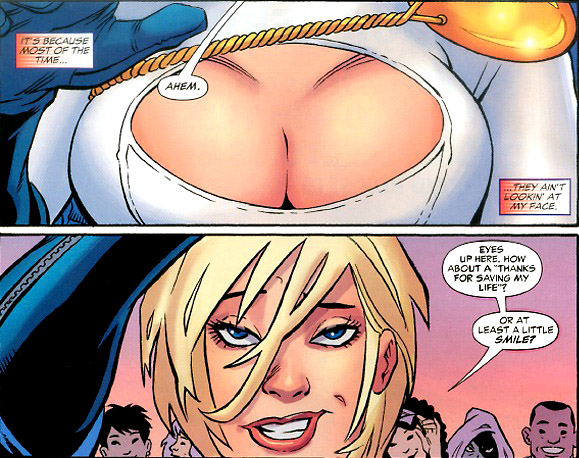
Ladies, your hope, essentially, lies with Wonder Woman and She-Hulk (I especially like She-Hulk, as she's been recently re-conned into some kind of super Nympho lawyer). Sure, there's others out there but they are the equivalent to Aquaman. Unless the film itself takes liberties with the material, no audience is going to flock to see Zantana on the big screen. They might flock to see a Power Girl movie but, trust me, it'll be for all the wrong reasons....

In comic books, women are generally supporting characters or are on a team. When they aren't, we try to make them into movies (hello Electra and Catwoman) and those movies suck.

By why not embrace the options?

For one, why does the female hero have to be either a) super or b) the titular star? Y, the Last Man is a comic book going to be made into a movie about a world where men are killed off in a plague-- and the main character, Yorrick, is largely a hapless dolt surrounded by stronger and fiercer women who have to save his ass all the time. Do you need this film to be "about" women when it's filled out by nothing but strong female characters?

And why do people always focus on super heroes? What, is Strangers In Paradice no longer a comic book? Wasn't Persepolis a graphic novel? Or Ghost World? Women, as characters, are often better explored (and less exploited) in non-super hero comics, why not use that for inspiration?

Are women really so eager to indulge in power fantasies?

And anyway, with Battle Angel Akira on it's way to being adapted, it's pretty clear that if you want some "female heroes" you're best bet is manga, not American comics. Check out the Borders aisles and you'll probably start to notice the difference....

The First Date Debate (or, once again, in praise of the Slut).

Over at The Frisky, there's a post extolling the virtues of not having sex on the first date-- a post inspired by a friend's husband, who said he'd never be with the friend is they'd slept together on the first date....


Edward, who has been happily married to my friend for over a year (after dating for four years before that), told me matter-of-factly, “If my wife and I had slept together on the first date, I can guarantee you we would have never been married.” This was almost insane to hear from him—they did not have a slow courtship at all. If I remember correctly, within three weeks they were saying I love you and within just a few months they were living together. Still, they waited at least a few dates before doing the nasty and Edward credits that for building up enough intrigue which eventually led to them falling in love and getting married. But sleep together right away and, “the mystery is gone before it can even be cultivated,” he said.


Edward, my friends, is an idiot.

I'd like to begin by saying that the essential problem with this romanticized view of sex, as if it were a gift to be unwrapped and if unwrapped too soon, the mystery will be lost, is threefold:

First, most of us have had sex before and it isn't terribly mysterious. It's just sex. It feels really good. And (here's the secret) it feels even better when you and your partner practice.

Secondly, there is the scarcity problem. At some point in a male's life, we may begin to understand the truth of the "Fish and the Sea" proverb: if a girl you are seeing will not have sex, there are always other girls who will. This is why girls who stop having sex in relationships shouldn't be terribly surprised that their man has cheated on them--- and especially so, with men in vice-versa situations (it's even easier for the woman, so you two had better be compatible). If you think keeping your "gift wrapped" through a few dates makes you "special" the person you're dating is likely dealing with a small pool of potential mates or is sexist, has gotten laid more than you or your friends have put together and believes you should be damn near a virgin. And he'll probably be jealous and possessive if he thinks you've screwed more than 2 guys (you dirty whore).

In my case, if you've made me wait, that sex better be phenomenal or the disappointment is going to make me break it off. Why waste valuable time for a lousy lay?

Lastly, this view of sex perpetuates a belief that is inherently negative towards women: that a woman's sole source of value is in their vagina. If you ask around, you'll find that some people believe there is some kind of inverse relationship between vaginal usage and the worth of the vagina's owner.

Or, roughly,


Kind of sick when you make it a graph, isn't it?


Edward's mystification of sex with his future wife is just a cover up for his basic belief that sex is the source of her value and that if she gave it too him too early, she is worthless.

And to him, personally, that may be true: but what does it say about you, that you'd sleep with a person who felt that way about you? Or what does it say about you, that you view yourself solely on the basis of your vagina?

Perhaps I'm the strange one, not to have such a view of sex. Maybe it's because the first girl I had sex with was a complete slut.

Now, when I say slut, I say, in this case, the conventional usage: she had a lot of sex, far too young to know what she was doing. She really did equate her vagina with her value and didn't value herself very much at all.

After all, when I first met her, my two best friends were trying to double-team her. I wasn't interested (I was 15 and had a handful of experiences with oral sex but had silly ideas about not having sex until ready).

Eventually, she pursued me (having refused my friends their good time), we began dating and I was taught a very valuable lesson: it's so much better to fuck someone who already knows how, than to start off clumsy. I had more, and odder, sex at 15 than most people I know had at 18 (with her, I began my great love of outdoor/exhibitionist sex).

Thus began my love of the slut. While I grew up and experienced personal growth, I found that my definitions of the word evolved from the common usage to something like a sainted position: the slut, as ultimate free spirit. The slut, as woman who isn't afraid to enjoy sex. With whomever they want. On their own terms.

I find them interesting, enticing: I love listening to women tell stories, I love sex and I love interesting things-- what's more interesting than listen to a woman tell stories about a lot of sex? And that's the great thing about the slut: she is so matter-of-fact, generally, that you may have these conversations. Detailed. Conversations.

She isn't uncomfortable with herself, with sex-- she likes to fuck and she'll fuck who she wants.

Tell me, who has more value? She who is in control of herself or she who fiercely protects her vaginal value from all comers, hoping to ensnare a man with her "mysteries?"

Mind you, it makes sense to protect yourself from those who would denigrate you: if a guy hates a slut, or would disrespect you, you probably shouldn't fuck him (unless you're into the slumming thing in which case more-- or less-- power to you).

Ladies, it isn't your vagina that will make a guy stop calling after the first date: it's you or it's him and there's nothing else to say about it. If it's you, you've had sex (or not), he didn't really feel a connection (with you and/or your vagina-- sorry, but sometimes it isn't you, personally, ladies) or if it's him, he wasn't looking for a commitment and it would have hurt all the more when he pursued you, finally had sex, and then stopped calling. Or maybe he's busy. Or maybe he's just a prick.

We're all adults, here. Have a conversation. Find out what the person wants. Find out what you want.

But in the end, keep in mind, always, that your value comes from who you are and that, at the very least, never fuck someone who has no respect for you-- even if it's after 14th date. It wouldn't turn out well, even if you got married later.

Wednesday, December 17, 2008

If They're So Fatale, Why Is No One Actually Hurt?

Thanks to Daniella for giving me the heads up on l'Homme Fatale-- sadly, she might disagree on my reading of it....
A few years ago, Katherine, an actress in her mid-20s who lives in Park Slope, was cast in a play by a theater director several years her senior. He wasn’t particularly attractive. In fact, he was almost effeminate. But he was intelligent and not too forward, and he was always surrounded by beautiful women—which, Katherine admits, she found intriguing.

“He seemed like the antithesis of all the jocky guys I went to high school with,” she said. (The women in this story agreed to discuss their romantic pasts only if identified by their middle names.) “He was sensitive, funny, supersmart, not athletic at all and not physically imposing. But there was something that was so charismatic—a gentleness and gracefulness and a confidence.”

Katherine and the director began a weeks-long courtship. There were late-night rehearsals in a dark theater that turned into surprisingly intimate later-night conversations. But then summer came. They both left New York for a while. And every time Katherine tried to reach him, he never returned her phone calls and ultimately disappeared altogether.

“People told me he was trouble, but I really thought he was too evolved and sensitive to hurt me the way he did,” Katherine said.

Katherine’s director was an Homme Fatale—a genre of man that New York women have come to know well. Often the creative type, he projects a deceptive vulnerability, while maintaining an appealing confidence. He’s usually not the best-looking guy in the room, but he is the smartest; he turns these traits to his advantage, playing up the contrast with the typical hot guy or womanizer (physical inferiority, emotional evolvement). His courtship begins with a rushed sense of intimacy and, yet, a disarming lack of forward physical advances; a first date might involve a game of Scrabble or perhaps a cup of tea; his target usually leaves wondering if in fact it was a date at all. And yet the story always has the same ending—he grows distant, stops calling and eventually disappears with little explanation, if any.


There's so much here, I don't know where to begin-- but a good place is this idea of "deceptive vulnerability" and being "too evolved to hurt me."

You find yourself dating the sensitive "perfect man," the kind that romantic comedies assure us are hiding under every rock but, lo and behold, he does the unthinkable: he grows quiet. He grows distant. He leaves you.

And that leaving hurts.

Has this happened to you? Congatulations, you've just gone through a break-up. It happens. But why is this, a normal occurance, somehow sinister under the "Homme Fatale?" The author never says he did anything except for not call. Katherine's sense of betrayal comes from herself and the reason is simple: she expected, because this man was "sensitive" and "evolved," that he was just another nester stereotype. That all sensitive men are the boyfriend type-- this sensitivity of theirs assures her some measure of control and security.

Surprise! It doesn't. Katherine's betrayal came from buying into a stereotype and centering her expectations around it. It's painful, yes, but where exactly is the Fatale to these Hommes?

Dangerous femme fatale heroines, as portrayed by Rita Hayworth in Gilda or Sharon Stone in Basic Instinct, are nearly extinct or have been reduced to tragic cougars while their male counterparts have only proliferated; now they can be found roaming the halls of magazines, publishing houses and the better English literature Ph.D. programs by day, and frequenting ironic dance parties in cramped Boerum Hill apartments by night. And unlike the typical womanizer, whose game is laughably easy to detect, the Homme Fatale’s modus operandi is more emotional and controlling than it is physical, leaving a wreckage that is, in the end, more disastrous.

(We pause here to note that the Homme Fatale, while related, is not the same as the oft-bemoaned indie rock or emo boy. While he may exhibit similarly sensitive qualities, an Homme’s emotional side is a learned part of his manipulation, not an authentic sentimentality.)


The Noir-era Femme Fatale character had particular traits, besides being beautiful and manipulative: they wanted something. They wanted a husband killed. They wanted some material object, some great and terrible favor. The love they elicited from men was of the obsessive kind, the kind that only a noir film could create: nihilistic, cynical, empty.

Often, those who wrapped themselves up with a Femme Fatale... actually died (if not that, went to jail or had some other terrible end).

The deadliness, in that era, was where their power came from: the allure was in the fact that these women were independent, blatantly sexual and always angling for themselves. That is what is fatal about the Femme Fatale.

And L'Homme Fatale, the so-called counterpart is... being sensitive as a trick? Well, what's this rotten bastard angling after, anyway? Sex?

The Homme Fatale has also slyly insinuated (as is to be expected) his way into popular culture. Take, for instance, the Aaron Rose character played by John Patrick Amedori on the teen drama Gossip Girl, the young downtown artist and RISD grad with the unfortunate goatee. In the six episodes in which his relationship with the glamorous, blond Upper East Sider Serena van der Woodsen has progressed in fits and starts, he has yet to actually have sex with her.


Okay... he's not trying to get laid? What makes him so terribly suspicious, then?

And for a somewhat nebbishy, shy person, he seems to have a suspicious number of beautiful female friends hanging around at all times. When Serena is justifiably confused by the other “muses” in his life, he simply says, “I could explain who Tamara is and why she was at my apartment last night, but the fact is, you feel something or you don’t. If you’re looking for an excuse to keep us apart, that’s fine.” It’s a classic Homme Fatale move: come on strong, then, when confronted with evidence that points to a lack of commitment or deception, turn it around so the woman feels like it’s her issue.


Again, we return to the problem of expectations. He's sensitive, he's shy but... he's surrounded by beautiful women? How dare he! That's Frat-boy behavior!

It's as if to say, if the guy doesn't walk like a Jock, quack like a Jock and fuck around like a Jock (and the funny part it, he doesn't seem to be fucking like a Jock at all), he's deeply betrayed someone by associating with a lot of women.

Let's just recap here a moment, shall we?

Femme Fatale:


:L'Homme Fatale.


The article later goes into a complete misreading of the Pick-up Artist stuff (I'll be writing about that at some point, I assure), making our "Homme Fatale" more sinister through association, despite the fact that the tactics of the two (PUA and HF) are clearly opposite. The manipulation meme is strong here-- how on earth could a man be sensitive and not be using that vulnerability as a way to emotionally manipulate women? Especially if-- gasp-- he leaves?

The article itself can't even answer that question as, in the end, it starts to contradict itself about how manipulative these Fatale Hommes are:
In my opinion, being an Homme Fatale is more of an affliction than a conscious course of action. I think you’re in love with the feeling as much as you are with each of those people. The Homme Fatale is not a slut, but the interest is both in the person, and even more so, in the feeling it gives you.”


Worse than a monster, then. A Romantic.

The Homme Fatale is neither a womanizer nor a sociopath—though these categories might overlap a bit.

“The Homme Fatale is a different, possibly more modern condition than a sociopath— he is not as aware of his actions. My understanding is that sociopaths are more clever and conniving. Maybe this is my personal bias, but I think the Homme Fatale is a slightly more sympathetic character,” said James. “The empathy is there, but people who do the most harm are people who don’t know what they want, and Hommes Fatales don’t know what they want.”


Gasp! Worse than a Romantic! He's the stereotype of a woman.

That's wrong of me, perhaps, but to this day I'll still hear that it's the right of every woman not to know what she wants.

So, too, is it the right of every man.

This article is emblematic of the Male Definition Problem: women have a expectations of behavior and feel betrayed when they are not met. And instead of blaming the female expectations, the males are blamed for exhibiting the exact same traits a female would bristle at being criticized over. All because no one knows what to expect of a "Man" anymore anyway-- emotion is encouraged yet, when displayed and someone is left hurt, it is then manipulative emotion, not true sensitivity. These expectations are tied into traditional gender roles: the more a male acts like a "female" (the article itself calls these hommes "almost effeminate"), the more he is expected to indulge in female-expectatant behaviors. And when he has "male-expectatant" behaviors, like emotional distance or haremizing? He's Evil and Wrong and Must Be Stopped.

No woman has the right to feel betrayed by a sensitive man who promises nothing, just as no man has the right to feel betrayed by a woman who doesn't give to him sexually. It's her right to choice to say no; it's his right to not know what he wants.

Public/Sex.


I am in love with My Hot Mess (mostly safe for work, but don't scroll down past mid-point, one naughty picture), the blog that insists it's not a blog.

It's raw, honest, brutal-- its writer talks about ignoring douchebag's she'd never date (while happy to use them for cheap ice cream), about her interactions with celebrities and coworkers and, in it's most recent, about how she's used loved one's and grown as a human being.

Oh. And she fucks for the camera. She's porn star/director Penny Flame and she must be one of the most public personalities in all of creation.

Imagine: getting on camera to have sex, displaying the most societally-intimate acts (although in the gonzo style, which isn't terribly intimate), putting them on the screen then opening up the lap top to admit to coke habits and a fucked up break up.

I am fascinated by the phenomenon of the public personality- and most especially by the female public personality. In them, there is a measure of instant fame that comes from being on the power-end of a relationship with a lustful audience.

How else do you explain others, like Paris Hilton, like Kim Kardashian, or that Alysson chick Gawker is so obsessed with?

In a way, it's like the Dominatrix (fodder for another post, I assure you); her audience is already a sexual fandom, worshipful of her body-- but is that enough? Apparently not: now, they need her heart, her mind, her private self and her public pussy.

That's quite a bit of "self" to be selling.

Question is, which side of the Porn Star argument do you go by? The empowered woman, controlling and profiting from her own sexuality-- or the Sarah Silverman, a thousand penises can't fill the hole in your soul argument?


It's hard to say, vis a vis her porn, but I love, respect and wish more of her written work-- (I wasn't actually familiar with her porno work-- I'd stumbled onto her from the totally NSFW Fleshbot site (kind of a Jezebel for porn)-- as the level of honesty she displays, there, helps every jerk-off and chump save himself, from himself:

Its good to play dumb when you are breaking someone’s heart in front of their coworkers. Nothing worse than the shit talking that commences as soon as dream girl walks over your heart and out the door with a big ass extra special cheap acai bowl. So I play dumb and he accepts my ignorance and I walk out that door, bowl in hand. It was this final interaction that I make it clear we would not be going on a date. Fuck, I mean, and I hate to say it because it makes me sound like a shallow fucking bitch, but really?

I’m just not going to date the guy from Robek’s. And while his employment at said smoothie shop is a big factor in me not dating him, there are other reasons as well. Here are my reasons for not dating the guy at Robek’s.

1. He works at Robek’s. This should explain itself, from the apron and the visor to the minimum wage paycheck. I need a self made nucca, who is driven and going places.

2. He has roommates. He’s mentioned them, and I am not into that.

3. He is my height. Fucking shallow bitch.

4. I have a hard time respecting people that hook me up because I am a pretty bitch. If you know me, and we are friends, fine, but just random good looking strangers? Come on dude, paying $5.95 for a bowl instead of $6.95 is not a big deal, and it isn’t going to impress me.

5. He works at Robek’s.


She admits to being shallow about his job, shallow about his height and, most importantly, disrespectful of the fact that he's giving her a cheap hook up as a way to get into her pants.

Basically, she's telling men (her primary audience) the truth about women (or, at least, herself). And that, my friends, is very necessary.

I was at a bar the other day, sitting with a girl who was pining over a guy there-- a guy there with another woman, who wasn't even as attractive as she was, who still had no interest in her.

I tried to tell her the truth, the same truth that I'd tell any guy: he's not only not into you, you look like an idiot. But of course, she didn't listen-- why should she? I'm just a guy in a bar and her future husband is the only man for her, so what do I, some dude, know about male psychology that she doesn't?

She's probably going to very visibly take someone home one night, having been rejected (again) and hoping to make him jealous somehow (it won't). But who am I to tell her the truth?

Enter Penny Flame, sex object: In telling the hard truth to the public, in being honest about herself, she gives the lessons to an audience who might be more receptive, if only because it gives insight into how to get into her (fantasy) pants.

She's in a position, as pornographer, to affect her audience's cocks and their behaviors.

She's also in a position to just seem more human. Imagine that: jerk-off material, thought of as a living, breathing person.

She isn't just a pussy and a pair of tits. She works out at Bally, knows Murs, hangs in Vegas, used to have a coke habit, needs to knock off with the weed and sometimes directs videos of her and her costars sucking the very real cocks of pretend strangers. What's more, unlike the Lindsey Lohans of the world, her frailties aren't exposed by the media, but herself. She creates a product (and uses herself as such), then engages in a dialogue. And well written, at that.

I have to say, from the profession to personality, I have nothing but respect.